
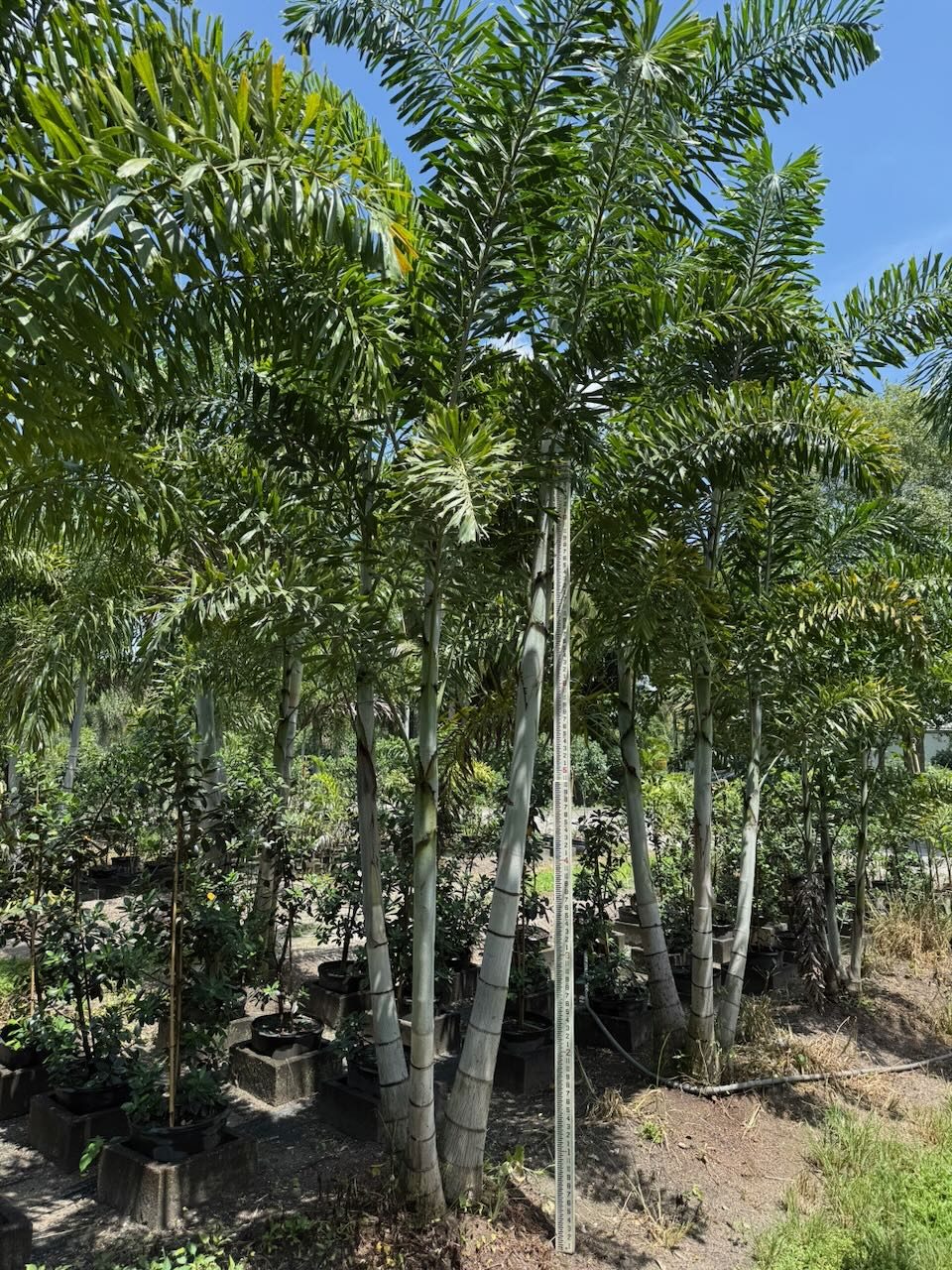
The Foxtail Palm (Wodyetia bifurcata) is one of the most requested specimen palms on South Florida landscape jobs. Clients see them at resorts, model homes, and high-end properties and want them in their own yards — and with good reason. A well-placed Foxtail Palm looks expensive, tropical, and polished, and the self-cleaning habit means the homeowner isn't calling you every month to come trim dead fronds.
This guide covers everything a landscape contractor needs to know when specifying, sourcing, and installing Foxtail Palms on a South Florida job.
Why Foxtail Palms Work So Well in South Florida
Native to Australia, the Foxtail Palm thrives in exactly the conditions South Florida delivers: intense sun, heat, and humidity. It grows quickly once established, tolerates our sandy soils, and performs consistently across Palm Beach, Broward, and Miami-Dade counties.
Its key advantages from a contractor's perspective:
- Self-cleaning: Old fronds shed naturally — no trimming required, no ongoing maintenance cost for clients
- Symmetrical canopy: The uniform, radiating frond pattern looks architectural and intentional
- Fast establishment: With proper watering, Foxtails push out new growth quickly after transplant
- Client appeal: High visual impact — one of the easiest palms to sell on a proposal
- Salt tolerance: Moderate to high — performs well in coastal environments
Single Trunk vs. Multi-Trunk: Which to Spec?
This is the most common design decision when specifying Foxtail Palms, and the right answer depends on the project context.
Single Trunk
The classic Foxtail look — one clean gray trunk rising to a full, symmetrical canopy. Single trunk specimens are ideal for formal entryways, driveway lining, and anywhere you want a clear vertical element. They're also the standard spec for street-side and median plantings where consistent sightlines matter.
Multi-Trunk
Multiple trunks grown together in a single root ball create a lush, full grouping with more visual mass at a lower height. Multi-trunk Foxtails are popular for pool surrounds, entranceways where you want immediate drama, and tight spaces where a single tall palm might look out of scale. They're also a great way to achieve a resort-style look in smaller yards.
Multi-trunk specimens typically cost more per plant but can deliver a more immediate and dramatic result, which can be easier to sell on high-end jobs.
Sizing Considerations
Foxtail Palms are sold by overall height (including canopy) or by grey wood (bare trunk) height. Understanding the difference matters when matching plants to a design:
- Small specimens (6–10 ft overall): More economical, best for long-term landscape plans where immediate impact isn't the priority
- Medium specimens (10–18 ft overall): The most common spec for residential jobs — good balance of cost and visual impact on delivery day
- Large specimens (18 ft+ overall): Used on high-end jobs where immediate drama is required. Higher cost but transforms a space on install day
Always discuss size expectations with the client using photos or site visits to comparable installations — "10 feet" means different things to different people.
Installation Best Practices
Foxtail Palms are forgiving once established, but the first few weeks after transplant are critical. Most early failures come down to underwatering during establishment — not disease, not pests, not soil issues.
- Dig width over depth. Dig the hole 2–3 times wider than the root ball and only as deep as needed — set the palm at or slightly above grade. Never bury the root ball deeper than it was in the container.
- Native soil backfill. In most South Florida sandy soils, backfill with native soil. Avoid heavy amendments that create drainage discontinuities.
- Water aggressively the first month. Deep water the root zone daily for the first 2 weeks, then every other day for another 2–4 weeks. This is the single most important factor in successful Foxtail Palm establishment.
- Stake larger specimens. Any palm over 10–12 feet in overall height should be staked for the first 4–6 months. Use wide strapping, not wire, to avoid trunk damage.
- Hold off on fertilizer. Wait until the palm shows active new growth (a new spear emerging) before applying fertilizer. A slow-release palm fertilizer with micronutrients is ideal.
Setting Client Expectations
One of the most common post-installation calls on Foxtail Palms comes from clients who notice older fronds yellowing or dropping shortly after installation. This is completely normal — transplant stress causes the palm to shed older fronds as it redirects energy to root establishment. Educate clients upfront so they don't panic.
What to tell clients:
- Some frond drop after installation is normal and expected
- New growth (a fresh spear emerging from the center) is the sign that the palm has established
- The palm requires no frond trimming — self-cleaning is one of its best features
- Apply magnesium or manganese if fronds show yellowing after establishment — micronutrient deficiency is common in South Florida's sandy soils
Frequently Asked Questions
How fast do Foxtail Palms grow?
Foxtail Palms grow at a moderate to fast rate — roughly 2–3 feet per year in height under good South Florida conditions. Growth rate is fastest during warm, wet months and slower in winter.
Are Foxtail Palms cold hardy?
Foxtail Palms are cold sensitive — they can sustain damage at temperatures below 40°F and are not suitable for areas north of USDA Zone 10. In South Florida, cold is rarely a concern except in unusual freeze events.
Do Foxtail Palms need to be trimmed?
No — this is one of their biggest selling points. Foxtail Palms are self-cleaning, meaning old fronds detach naturally as they dry. There is no need to prune fronds, and doing so can actually stress the palm. Only remove fronds that are completely brown and hanging.