
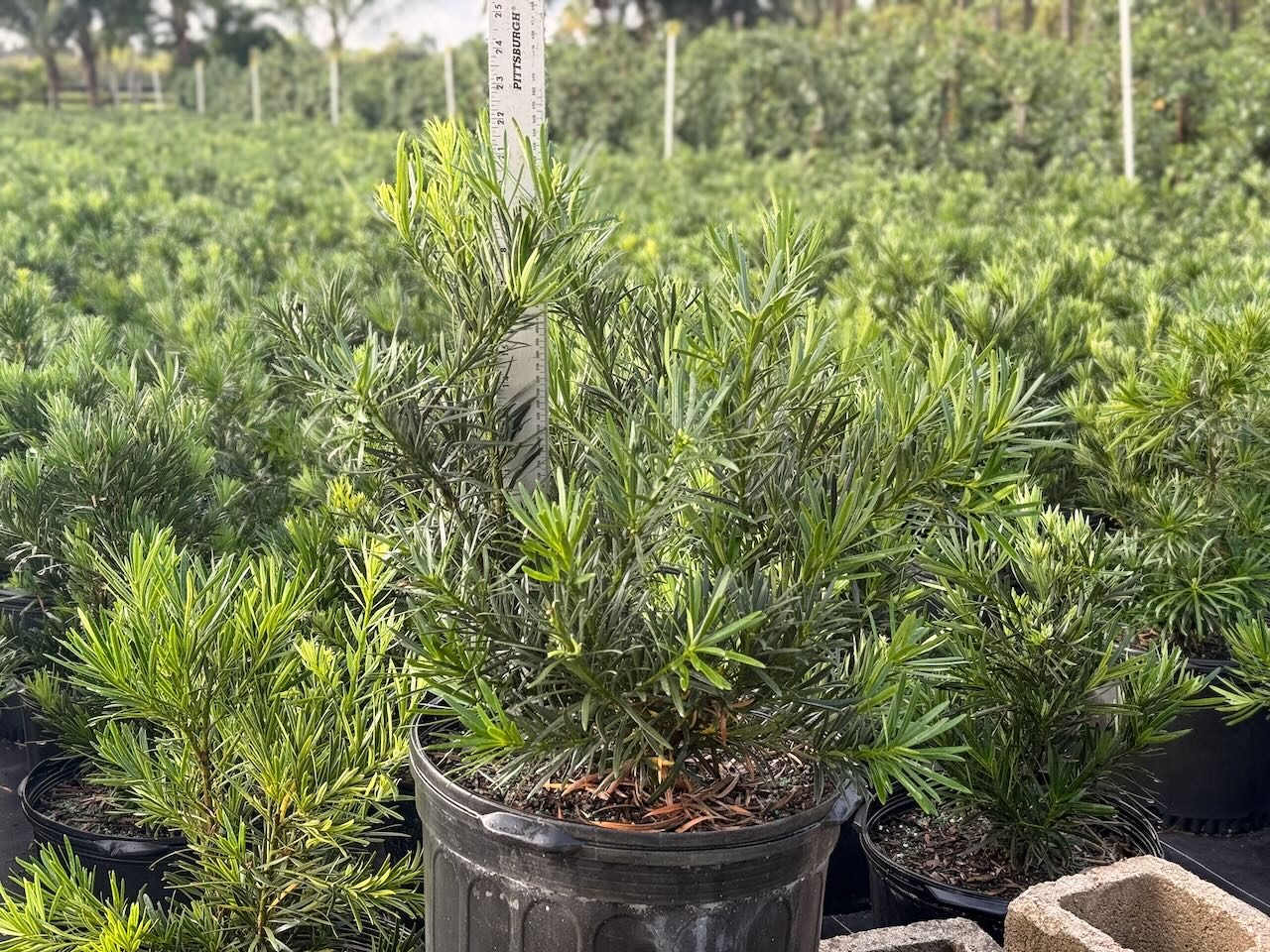
Podocarpus has earned a permanent place in the South Florida landscape contractor's toolkit. While Clusia gets more of the volume, Podocarpus fills a specific niche that nothing else quite matches: the formal, architectural hedge. When a client wants something that looks like it was cut with a straight edge — flat top, flat sides, precise corners — Podocarpus delivers that look better than almost any other plant we grow in this climate.
This guide covers how to spec, install, and maintain Podocarpus on South Florida landscape jobs, with a focus on the applications where it outperforms the alternatives.
Understanding Podocarpus: Key Varieties
Two Podocarpus varieties are commonly used in South Florida landscape work:
- Podocarpus macrophyllus (Japanese Yew / Yew Pine): The most widely used variety. Upright growth habit, medium-fine texture, dark green foliage. Excellent for tall formal hedges and columnar accents.
- Podocarpus macrophyllus 'Pringles' (Podocarpus Pringle): A more compact, denser-branching cultivar that stays lower naturally. Better suited for low-to-medium hedges, foundation plantings, and situations where you want density without as much height management.
For most hedge applications, standard macrophyllus is the more common spec. Pringle is increasingly popular on jobs where a tighter, lower profile is the goal.
Why Podocarpus Works in South Florida
- Formal aesthetic: Takes a flat, architectural shear better than Clusia — holds a precise edge between trimmings
- Whitefly resistance: Excellent — one of the most whitefly-resistant hedge options available
- Drought tolerance: High once established — very low irrigation demand on mature hedges
- Upright growth habit: Natural columnar form is ideal for tall hedges in narrow spaces
- Adaptability: Performs in full sun to part shade across a wide range of South Florida soil types
Best Applications for Podocarpus
Formal Privacy Hedges
This is Podocarpus at its best. A well-maintained Podocarpus hedge trimmed to a flat wall looks refined, intentional, and expensive — especially on estate and HOA properties where a manicured appearance is expected. It's the go-to spec when clients show you inspiration photos of European-style formal gardens.
Pool and Patio Surrounds
Podocarpus's upright habit and fine texture make it ideal for pool enclosure screening where you need height without bulk. It creates a clean backdrop for the pool area without the tropical lushness of Clusia, which can feel too informal for more contemporary or transitional designs.
Tight Spaces and Narrow Plantings
Between a wall and a walkway, between a fence and a property line — anywhere the planting bed is narrow but you need height, Podocarpus's columnar form is a natural fit. It won't sprawl into the walkway the way Clusia or other hedges might.
Entry Columns and Definition Plantings
Podocarpus can be maintained as tall, columnar pillars flanking an entry or driveway — a formal look that photographs extremely well and holds its shape with periodic trimming.
Sizing and Spacing
- 3-gallon: 18–24 inches on center for dense coverage. Budget 12–18 months to a full hedge appearance.
- 7-gallon: 24–30 inches on center. Most common residential spec — good fill speed at reasonable cost.
- 15-gallon+: 30–42 inches on center. Used where faster coverage or immediate screening is required.
Podocarpus grows more slowly than Clusia, so slightly tighter spacing is often justified on jobs where the client wants to see results within one season.
Installation Notes
- Plant at grade or slightly above. Avoid planting too deep — Podocarpus doesn't tolerate standing water around the crown.
- Well-draining soil is important. While adaptable, Podocarpus doesn't perform well in chronically wet or poorly drained soil. Avoid low-lying areas.
- Establishment watering: Water consistently for the first 6–8 weeks after planting. Once established, Podocarpus is notably drought tolerant.
- Mulch: 2–3 inches of mulch along the hedge line helps maintain moisture and moderates soil temperature during establishment.
Trimming and Maintenance
Podocarpus grows more slowly than Clusia, which is both an advantage and a tradeoff. On maintenance accounts, you'll typically trim Podocarpus hedges 3–4 times per year to keep a precise appearance, compared to 6+ times for a fast-growing Clusia hedge that clients want kept tight.
When shearing, cut with flat edges — Podocarpus responds well to mechanical hedging and produces dense new growth along the cut surface. For the cleanest result on formal hedges, use a string line or laser level as a guide on the top cut.
Avoid cutting into thick, bare old wood — recovery is slow. Keep up with regular trimming so you're always cutting into green, actively growing material.
Podocarpus Pringle: The Compact Cultivar
Podocarpus Pringle (sometimes called Dwarf Podocarpus or Shrubby Yew Pine) has become increasingly popular in South Florida landscape work over the last several years. It's a more compact, denser-branching selection that stays naturally lower — typically 3–6 feet with minimal trimming — making it useful in applications where standard macrophyllus would require constant height management.
Pringle works particularly well as a foundation shrub, low formal hedge, or accent plant where you want the refined Podocarpus texture at a smaller scale. It's also a strong performer in container applications for commercial entrances and patio settings.
Frequently Asked Questions
Is Podocarpus deer resistant?
Yes — Podocarpus is generally considered deer resistant, which is a useful selling point on properties in areas with deer pressure (particularly western Palm Beach County communities near the Everglades corridor).
How does Podocarpus compare to Clusia for privacy hedges?
Both are strong choices with excellent whitefly resistance. Podocarpus delivers a more formal, structured appearance and works better in tight spaces due to its upright habit. Clusia grows faster, tolerates more coastal exposure, and has a bolder, more tropical look. For most standard residential privacy hedges, the choice comes down to design aesthetic and client preference.
Can Podocarpus grow in shade?
Yes — Podocarpus tolerates part shade well and maintains decent density even in lower light conditions. In full shade, it may become more open. It performs best in full sun to part shade.