
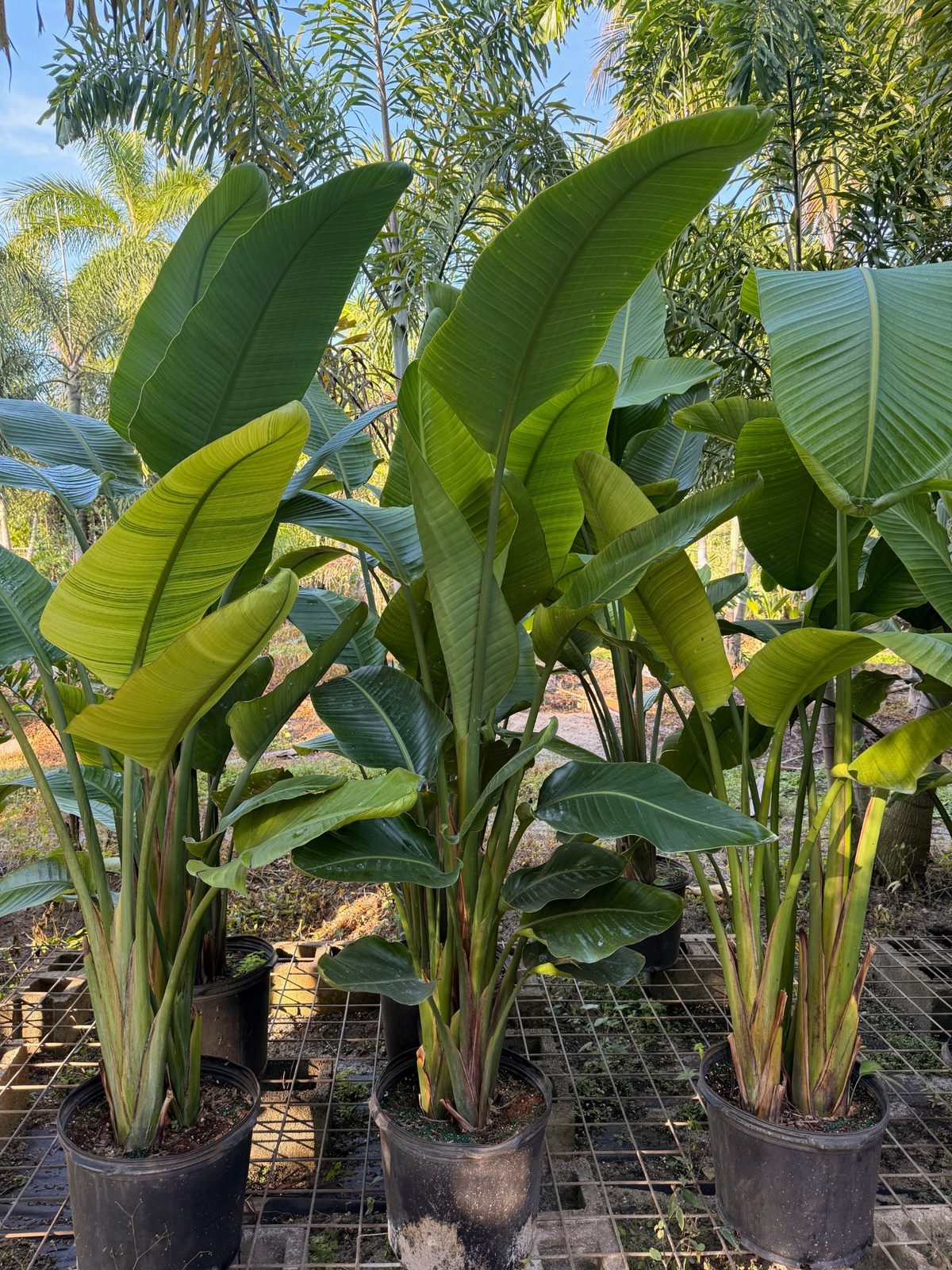
White Bird of Paradise — Strelitzia nicolai — has become one of the most requested accent plants on South Florida landscape jobs over the last several years. Its enormous paddle-shaped leaves, upright clumping form, and ability to reach 15–20 feet give it a dramatic, resort-style presence that few other plants can deliver. When a client wants something that makes a statement, White Bird is often the answer.
This guide covers how to use White Bird of Paradise effectively on South Florida landscape jobs — where it works best, how to install it, and what clients need to know for long-term maintenance.
What Makes White Bird of Paradise Effective in the Landscape
White Bird of Paradise succeeds in South Florida for a combination of reasons that make it genuinely useful to landscape contractors:
- Scale: Its large leaves create visual weight and presence that smaller plants simply can't. A few well-placed specimens can anchor an entire landscape design.
- Speed: It grows fast — significantly faster than most comparable tropical accent plants. Clients see results quickly, which matters for satisfaction and referrals.
- Versatility: Works in full sun or part shade, and performs consistently across South Florida's range of soil conditions.
- Low maintenance: Once established, it requires minimal care — no regular trimming, no serious pest problems, and good drought tolerance after the first season.
- Flowers: Mature plants produce striking white and blue blooms, adding ornamental value that the client didn't necessarily expect.
Best Landscape Applications
Corner Anchor
White Bird of Paradise is one of the best corner anchor plants available for South Florida residential landscapes. Placed at the corner of a structure or at the end of a planting bed, a mature specimen draws the eye and gives the landscape a finished, intentional look. Its upright form doesn't sprawl into walkways or obstruct views at lower heights the way a wider-spreading plant would.
Focal Point / Specimen Planting
A single large White Bird of Paradise placed strategically — at the end of a driveway, flanking an entry, or centered in a bed — creates a dramatic focal point that clients consistently photograph and show to their friends. For landscape contractors, it's a high-visibility plant that generates referrals.
Privacy Screen at Scale
Planted in a row, White Bird of Paradise creates an informal but dense privacy screen that reaches substantial height without the maintenance demands of a formal hedge. It won't give the same solid wall as Clusia or Podocarpus, but for clients who want a tropical, naturalistic screen rather than a manicured hedge, it's an excellent choice.
Pool and Patio Backdrop
The large, graphic leaves of White Bird of Paradise photograph exceptionally well against pool water and tile. It's become a standard spec on higher-end pool renovations and new construction landscaping throughout Palm Beach County. Its size provides shade value at maturity without dropping messy debris into the pool.
Mixed Tropical Compositions
White Bird of Paradise works well as the dominant tall element in mixed tropical plantings. Pair it with Areca Palms, Clusia, Green Island Ficus, or ornamental grasses for layered designs that have depth and movement.
Sizing Considerations
White Bird of Paradise grows quickly, so the sizing decision is mostly about how immediately the client wants the full effect.
- Smaller containers (7–15 gallon): More economical for large-scale installs. Will reach impressive size within 2–3 growing seasons in South Florida's climate.
- Larger containers (25 gallon+): Delivers more immediate visual impact on install day. The right call for high-end jobs where the client is paying for a finished-looking landscape from day one.
For focal point or specimen applications, larger material is almost always worth the investment. For mass planting or privacy screens where volume matters more than individual plant size, smaller containers at tighter spacing deliver better overall value.
Installation Notes
- Give it room. White Bird of Paradise spreads as it matures — a clump can reach 8–10 feet wide at full size. Plant it where it has space to grow without crowding structures or walkways. Clients often underestimate how large these get.
- Plant at grade. Set at the same depth as in the container. Good drainage is important — avoid low-lying areas with standing water.
- Establishment watering: Water consistently for the first 4–6 weeks after planting. Once established, White Bird of Paradise is moderately drought tolerant and can largely sustain itself on South Florida's rainfall outside of prolonged dry spells.
- Sun or shade: Performs well in both. Full sun produces faster growth and flowering. Part shade produces larger, darker leaves. Either works — match to the site conditions.
Setting Client Expectations
A few things worth communicating to clients upfront to avoid callbacks:
Leaf splitting is normal. The large leaves of White Bird of Paradise split along their margins in wind — this is a natural characteristic of the plant, not damage or disease. Clients who aren't warned about this sometimes call thinking something is wrong. A quick explanation upfront prevents the conversation.
It will get large. White Bird of Paradise can reach 15–20 feet at maturity in South Florida. Clients who plant it under eaves or too close to structures will eventually have a problem. Make sure placement accounts for mature size.
Flowering takes time. The spectacular white and blue blooms typically appear on plants that are several years old and well-established. Don't set the expectation that a newly planted specimen will flower in the first season.
Trunk suckers. Like Areca Palms, White Bird of Paradise produces offshoots at the base over time. These can be removed to keep a clean, single-clump appearance or left to expand the grouping. Discuss client preference when the plant is installed.
Long-Term Maintenance
On maintenance accounts, White Bird of Paradise is one of the lower-effort plants in the South Florida landscape. The main tasks:
- Fertilization: Apply a balanced slow-release fertilizer in spring and summer. This is not a heavy feeder, but regular fertilization keeps the foliage a deep, healthy green.
- Leaf cleanup: Older leaves eventually yellow and die back at the base of the clump. Remove these periodically to keep a tidy appearance — they don't fall cleanly on their own the way palm fronds do.
- No regular trimming needed: Unlike hedges, White Bird of Paradise doesn't require shaping or trimming. The natural form is the intended look.
- Irrigation: Moderate water needs. In South Florida's rainy season, established plants are largely self-sufficient. Supplemental irrigation during dry season maintains best appearance.
Frequently Asked Questions
How fast does White Bird of Paradise grow in South Florida?
In South Florida's climate, White Bird of Paradise is a fast grower — it can put on 3–4 feet of height per year under good conditions during the warm growing season. It's one of the faster large accent plants available in the wholesale market.
Is White Bird of Paradise the same as the orange Bird of Paradise?
No. White Bird of Paradise (Strelitzia nicolai) is a different species from the more commonly known orange Bird of Paradise (Strelitzia reginae). The white variety grows much larger — 15–20 feet versus 3–5 feet — and produces white and blue flowers rather than orange. The two plants have similar cultural requirements but very different uses in the landscape.
Can White Bird of Paradise grow in a container?
Yes, for a period of time. It's used in large decorative containers for commercial entrances and covered outdoor spaces. However, it will eventually outgrow any container and performs best when planted in the ground where its roots can spread freely.
Is it salt tolerant?
Moderately. White Bird of Paradise tolerates some salt exposure but is not among the most salt-tolerant plants available for coastal landscapes. For properties directly on the water with significant salt spray, Clusia or Areca Palms are more reliable choices.